While we can all agree that 2021 was an improvement over 2020, the year left much to be desired in terms of economic (and life) stability — massive labor market shifts, supply chain disruptions, and historic inflation. The “wet blanket” of COVID variants did not help the cause either. Businesses will continue to grapple with these challenges in 2022. But there is a way to navigate the ‘flotsam’ of the past couple years and to ensure this year is productive and positive. It takes, however, some shrewd risk-taking and a shift in thinking.
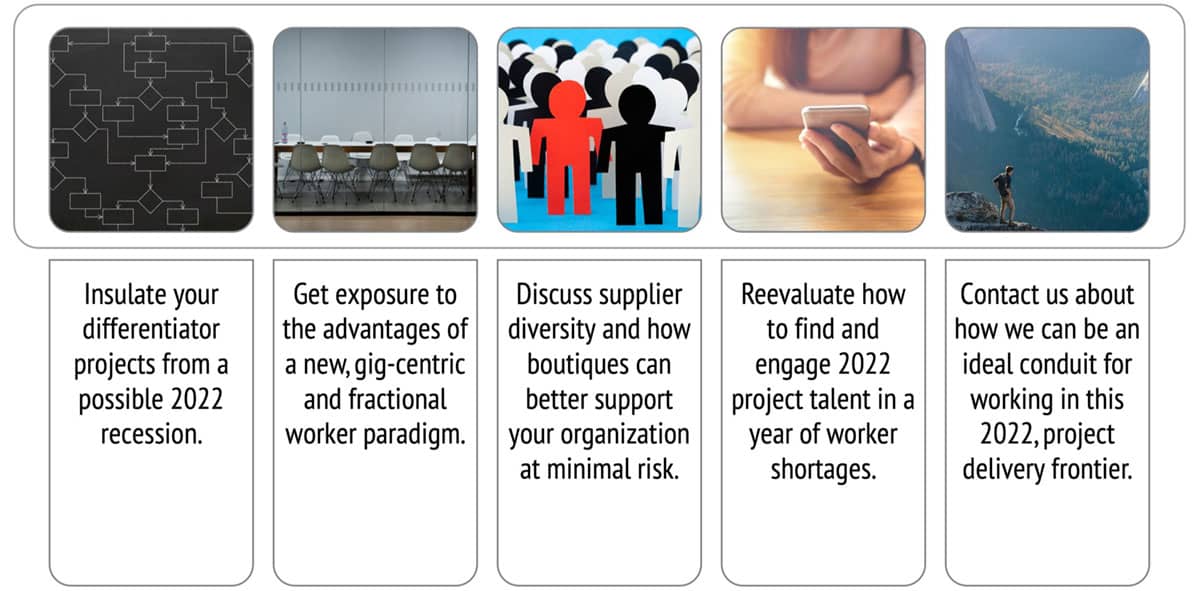
Below are our tips (and predictions) for project success in 2022.
1. Prioritize differentiator projects in the face of a possible recession
While some prognosticators see 2022 as a continuation of post-pandemic recovery, we can’t ignore the inflationary elephant in the room. In the early 1980s, we had similar inflation woes. The treatment, proposed by then Fed Chairman Paul Volker, was to tighten monetary policy with rate hikes. The tradeoff was a recession in Fall 1981. Fortunately, the gamble worked. Volker brought inflation to heel, and the following year, we were out of the recession.
Today, unless inflationary numbers cool, we will see more hikes from our growingly hawkish Jerome Powell, the Federal Reserve Board (FRB) chair. If history repeats itself, then Powell is making the same tradeoff as Volker did — a recession.
A recession doesn’t necessarily mean cutting projects. Rather, executives should revisit their 2022 project portfolio and reevaluate projects in flight. Projects that differentiate their business should be insulated as much as possible:
- Business cases and feasibility studies should be updated with a recession in mind;
- Projects that are in flight may need to be fast-tracked to “clear the proverbial decks” for a rocky 2nd half of 2022;
- Lower priority projects should be liquidated for contingency dollars to support the higher priority ones.
Of course, these are not moves to be made in a vacuum. They require checks of economic and organizational “tea leaves” throughout the year and honest dialogs with project stakeholders.
2. Buy into the fractional, gig-centric economy

Organizations bemoan the difficulty of finding available, quality, and affordable W2s (especially if those employees need to work on site). What is now coined as the “Great Resignation” or “Big Quit” is, at least in project management circles, a huge workforce shift towards a gig-centric, fractional work and lifestyle.
With the rapid advancement of online collaboration tools over the years, we have witnessed a normalization of remote flexibility, worker independence, and 1099 “sole-proprietorism.” The pandemic simply threw gas on that fire. Project managers are liberating themselves from an employee-centric model. With the exception of the “operational” side of project management (such as a Program or Project Management Office (PMO)), W2 project managers are becoming an 2022 anachronism.
Rather than fighting against this current (often at the expense of the more promising talent options), organizations should evaluate the advantages of a gig-centric and fractional worker paradigm to deliver projects in 2022. We delve more into this topic in tip #3.
3. Seek supplier diversity and shake up the old (pre-2020) preferred vendor lists

Organizations need to fundamentally alter where they look to find talent. With the workforce market having shifted beneath our feet, many organizations (especially larger corporations) are likely operating with outdated preferred vendor lists and selection models. Vendor management (usually handled via a Vendor Management Office, or VMO), is intended to be an objective party in the selection process. They define contracting criteria and establish preferred vendor lists. They set terms, conditions, standardized pricing (rate cards). And while they have a place and purpose to curb the chaos and collusion of vendor selection, to the vendors themselves, VMOs are a gatekeeping tool. But VMOs are notorious for being monolithic and slow. Supplier lists aren’t usually updated but every 3-to-5 years. Thus, many VMOs are likely struggling to keep up with the massive labor migration.
The post-pandemic world is the age of the small, boutique provider. VMOs are better served diversifying their suppliers with boutique providers and gig-centric project managers. Besides, under the clouds of a recession, a gig-centric vendor strategy is a smarter play while fixed employee costs are something to avoid in 2022.
4. Attracting talent — “It’s the projects, stupid!” Not roles and titles

We stated in last year’s tips that “Project delivery work, especially at a senior, specialist-level, is tailor-made for a consultant, fractional, and gig workforce.” Again, the Big Quit magnified that reality. The Project Managers who are thriving in this reality aren’t looking for generic, hierarchical positions. They are looking for attractive projects. In order to widen the net for attracting project management leaders, organizations need to rethink and even simplify recruitment messaging (more akin to Request for Information (RFI) or Request for Quote (RFQ) solicitations).
While organizations are frustrated by the labor challenges posed by the pandemic, the refreshing new reality, at least for finding quality project managers, is that the project IS the motivator. Requisitions for project delivery services should be about selling project managers on the project and objective. The common attractors of title, seniority, stability, and even cultural fit don’t hold as much sway in a gig-centric economy as they did pre-pandemic. They’re merely nice-to-haves. Moreover, from a career development and brand-building perspective, it is the diversity of project experiences (and delivery successes) that project managers are seeking (as we’ll discuss in tip #5).
5. For Project Managers, cultivate a brand of independent delivery excellence

2022 presents exciting career options for project managers, especially those taking the leap of faith to leave employment for either consulting or 1099 self-employment. 2022 is, in a way, a new frontier of worker sovereignty. That sovereignty, however, poses heightened expectations of individual leadership and delivery excellence. There is nowhere to hide from the accountability that comes from working under your own banner or that of a small boutique. There is also very little customer patience for ineffectiveness.
In 2022, the project manager “brand” is not just defined by baseline experience and industry certifications. It carries far higher expectations required of a market that is in a lot of flux:
- Being able to deliver projects in lean organizations without the luxuries of established processes or PMOs;
- Adapting and creating tools and solutions from scratch whenever needed;
- Navigating (on your own) challenging cultures and organizational tribalism;
- A rugged determination to see projects to their end.
Admittedly, this brand development requires many projects and diverse challenges over time. It comes from being well-read; naturally curious; and open to taking risks. It means studying group dynamics; customer service and salesmanship; and most importantly, honesty and professional ethics.
For those who truly love leading projects and are motivated by these expectations, 2022 is going to be a fun ride!